

What is the Kombo Default Fallback?
When you override a field mapping, you replace Kombo’s built-in mapping logic with your own custom configuration. This is powerful, but sometimes you don’t want to replace Kombo’s logic entirely — you want to combine your custom mapping with Kombo’s standard logic in a specific priority order. The Kombo Default Fallback lets you insert Kombo’s standard mapping logic as one of the priorities in your fallback chain. This means you can:- Use a custom integration field as the primary source, and fall back to Kombo’s default if that field is empty
- Use Kombo’s default mapping as the primary value, but override it with a custom field when Kombo’s value is empty
- Place Kombo’s default logic between two custom field sources in a multi-level fallback chain
The Kombo Default Fallback is available for simple (string, number,
boolean), enum, and date field remappings. It is not available for
address, reference, or array field types.
When should you use it?
Consider using the Kombo Default Fallback when:- Kombo’s default mapping works well in most cases, but a small number of your customer’s records store the value in a different field. You can set Kombo’s default as Priority 1 and your custom field as a fallback.
- A custom field is your preferred source, but it isn’t always populated. By adding Kombo’s default as a fallback, you ensure no data is lost when the custom field is empty.
- You want to experiment with a custom mapping without losing the safety net of Kombo’s proven default logic. If your custom source produces
null, Kombo’s standard mapping takes over automatically.
How it works
The remapping engine evaluates your fallback chain from top to bottom (Priority 1 first, then Priority 2, and so on). For each record (employee, candidate, job, etc.), it checks each priority in order and stops as soon as a valid, non-empty value is found. When the engine reaches a “Default Kombo value” entry in the chain, it uses the value that Kombo’s standard mapping logic would have produced for that field — exactly as if no remapping had been configured.Example: Custom field with Kombo default as safety net
Suppose you want to map thefirst_name field from a custom integration field called preferred_name, but not every record has a preferred name set.
Result: Records with a
preferred_name get that value. Records without it seamlessly fall back to whatever Kombo would have mapped by default.
Example: Kombo default with a custom override
You trust Kombo’s mapping for most records, but for a few edge cases you know a specific integration field has better data.
Result: Kombo’s default logic runs first. Only when it returns nothing does the system check
backup_field.
Adding a Kombo Default Fallback
- Open the remapping modal for the field you want to configure (see simple, enum, or date remapping for details on how to open the modal).
- At the bottom of the modal, click the Fallback to Kombo’s mapping button.
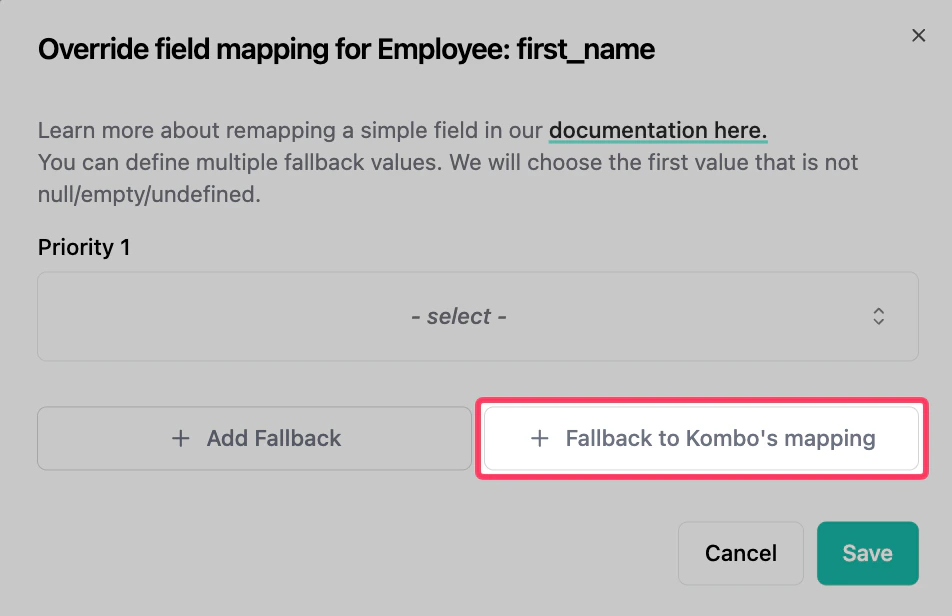
- A new priority entry will appear showing “Default Kombo value” with the description “Uses Kombo’s standard mapping logic for this field.”
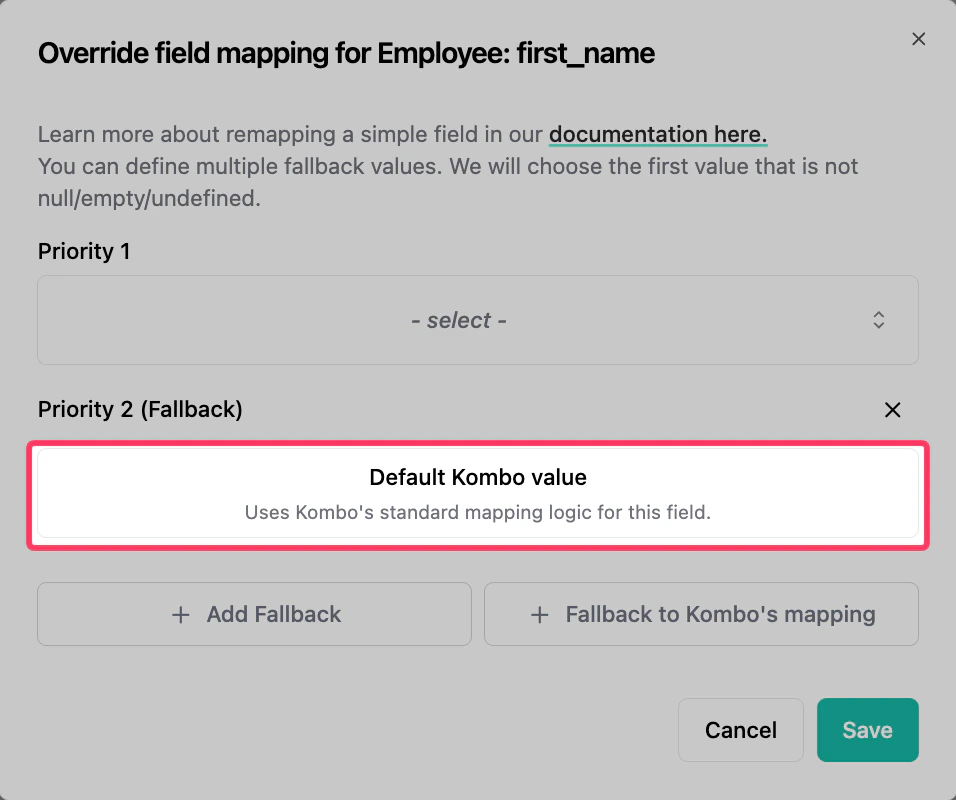
- You can reorder priorities by removing and re-adding entries. The Kombo Default Fallback can be placed at any position in the fallback chain — it does not have to be last.
- Click Save to apply the configuration. Remember that a sync is required for saved changes to take effect.
Combining with other fallbacks
You can freely mix Kombo Default entries with custom integration field entries. For example, a three-level fallback chain for an enum field might look like:
The engine will try
custom_status_field first. If it’s empty, it falls back to Kombo’s default enum mapping. If even that produces null, it tries legacy_status_field as a last resort.